COMPUTATIONAL MODELING OF VECTOR FIELDS IN EXCEL
Keywords:
Modeling in Physics, Scientific Excel, Numerical simulation, STEM educationSynopsis
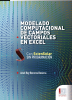
The book Computational Modeling of Vector Fields in Excel with ScienSolar (Ariel Rey Becerra Becerra, 2026) is an innovative guide for modeling three dimensional physical phenomena within Excel spreadsheets, utilizing the ScienSolar simulation add in. It is aimed at students and researchers, enabling them to create models without the need for advanced programming. The work first addresses the mathematical foundations of scalar and vector fields, explaining their representation in Cartesian, cylindrical, and spherical coordinate systems using transformation matrices. It then details the use of the ScienSolar package, which facilitates the construction of modular models with controls, data input fields, 3D visualization, and the execution of adjustable simulations.
The book includes modules for vector trajectories and di!erential operators, and illustrates concepts with images created in Excel. As an academic resource, it integrates theory, computational practice, and educational technology, standing out for its active learning approach and intuitive visualization, making it useful for both teaching and research.
Downloads
References
I. N. Bronshtein and K. A. Semendyayev, Manual de matemáticas. Moscú: Mir, 1997.
B. M. Yavorski and A. A. Detlaf, Prontuario de física. Moscú: Mir, 1988.
H. C. Ohanian and J. T. Markert, Física para ingeniería y ciencias, 3ra ed. Nueva
York: McGraw-Hill, 2009.
D. J. Cooke and H. E. Bez, Computer mathematics. Moscú: Nauka, 1990. (En ruso).
E. A. Volkova, A. M. Popov, and A. T. Rakhimov, Quantum mechanics on the personal computer. Moscú: URSS, 1995. (En ruso).
G. G. Guzman Guzman and J. S. Santoyo Diaz, “Diseño de una aplicación con realidad aumentada en la creación de contenidos educativos”, RCTA, vol. 2, no. 44, pp. 142–152, Jul. 2024, doi: 10.24054/rcta.v2i44.3032.
L. A. . Lasso Cardona, E. . Rincón Reyes, and G. D. . Estrada Holguín, “Introducción a la evaluación de capacidades: una revisión teórica”, RCTA, vol. 2, no. 36, pp. 34–43, Jul. 2020, doi: 10.24054/rcta.v2i36.18.
Microsoft, “Referencia de VBA para Excel,” 2022. [En línea]. Disponible: https://learn.microsoft.com/es-es/office/vba/api/overview/Excel.
V. I. Kildishov, MS Excel and VBA to modeling of di!erent problems. Moscú: Solon-Press, 2018. (En ruso).
Fisica.ru, Física que cambia el mundo, 2022. [En línea]. Disponible: https://www.fisica.ru.
ScienSolar, Sitio informativo de ScienSolar, 2022. [En línea]. Disponible: https: //sciensolar.com.
Downloads
Published
Series
Categories
License

This work is licensed under a Creative Commons Attribution-NonCommercial 4.0 International License.